
The summer of 2025 had started like any other on Roblox. Millions of children and teenagers logged in daily to build worlds, trade virtual pets, and chase elaborate in-game adventures. But everything changed in mid-August. The state of Louisiana filed a lawsuit, accusing the platform of failing to protect its youngest users from predators and explicit material. Roblox Corporation pushed back immediately, calling the claims "erroneous" and pointing to years of investment in moderation tools. Despite the denial, the legal pressure forced a reckoning that would permanently alter how the platform handled age-restricted content.

The first move arrived within weeks. On August 29, 2025, Roblox quietly removed all "Restricted" experiences from the search results and recommendation feeds visible to users under 18. For a generation of teenagers who had grown up on the platform, it felt like an invisible wall had gone up overnight. Entire genres of mature roleplay servers, horror games with psychological scares, and dating-themed hangouts simply vanished from their feeds. The shift was a straightforward attempt, the company explained, to limit the visibility of material inappropriate for younger eyes.
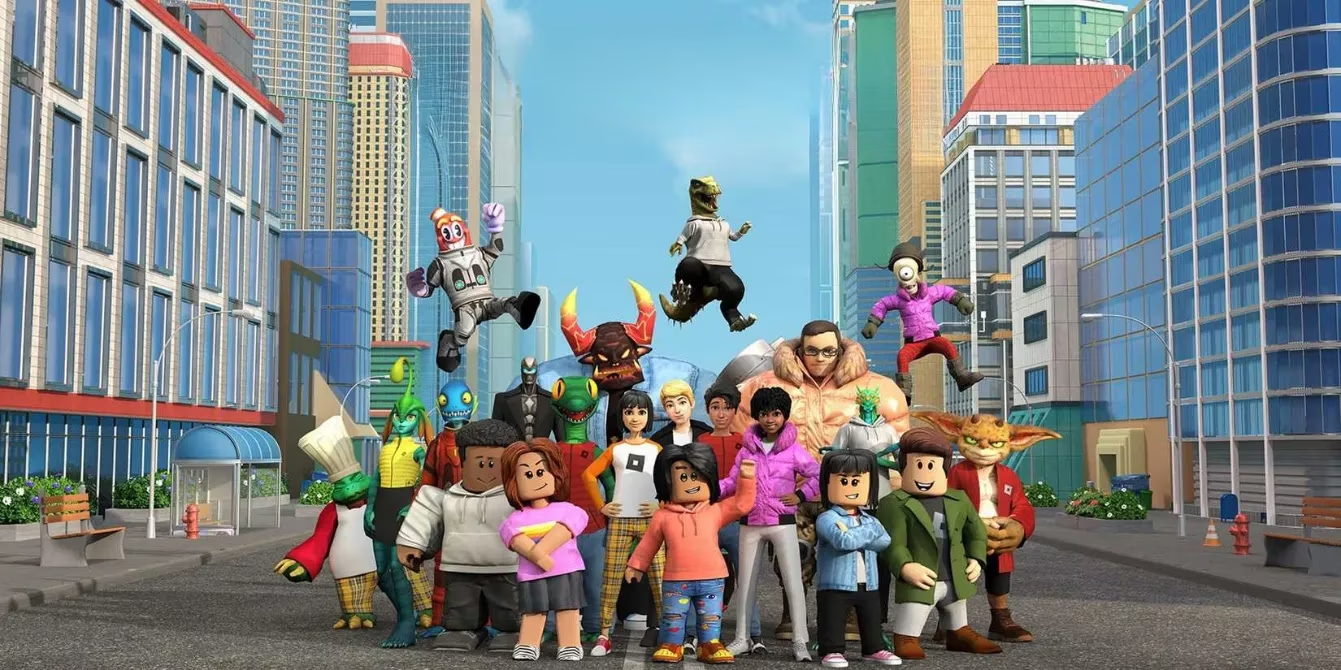
The real earthquake, however, was scheduled to hit before the year's end. Roblox announced it would raise the minimum age for accessing Restricted-rated experiences from 17 to 18. This was not just a visibility tweak; it was a hard gate. Any player who had not yet celebrated their eighteenth birthday would be completely blocked from entering those digital spaces. The company promised to implement the change before the close of 2025, and by December the new age gate was live. Overnight, thousands of 17-year-old players who had previously built social lives inside adult-oriented hangouts were locked out.
An exception was carved out for young creators. A 17-year-old developer who had already published a Restricted experience could still visit and maintain their own creation. They could not, however, release a single new Restricted-rated game until they turned 18. The burden fell hard on teenage visionaries like Ethan, a fictional composite of many real developers. Ethan had spent months crafting a narrative-driven thriller with mature themes, carefully skirting the edge of Roblox's content rules. After the policy change, his dashboard showed a stark warning: new Restricted uploads were suspended pending age verification. He would need a government-issued ID to prove his adulthood, a process completed through the Account Info tab buried in the settings menu.
The age verification requirement ignited a firestorm. Veteran accounts, some older than a decade, suddenly had to hand over driver's licenses or passports to regain access to the communities they had helped build. A 20-year-old player who had joined Roblox in 2009 was treated the same as a new registrant. "My account is 15 years old," a typical complaint read on forums, "why do I need to prove I'm an adult?" Roblox held firm, insisting that account age alone was unreliable because children often inherited or shared older profiles. The friction was real, but so was the company's determination to silence the critics who had accused it of turning a blind eye.
Layered on top of the Restricted overhaul was another cleanup effort announced for September 30, 2025. All experiences without a maturity rating were to be disabled. Developers had to explicitly label every single game, whether it was a silly obby or a gritty survival sim. This blanket enforcement aimed to eliminate gray zones where inappropriate content might slip through unclassified. By early 2026, the platform felt significantly more segmented. Parents could breathe easier knowing search results had been sanitized for their children, while adult users retreated to verified corners of the platform.
As 2026 progresses, the effects of the 2025 policy tsunami are still rippling outward. Analysts note that Roblox's daily active user numbers dipped slightly among the 17-18 demographic immediately after the age gate tightened, but child safety advocates have largely praised the moves. The Louisiana lawsuit was eventually settled out of court, its detailed terms sealed from public view. Meanwhile, Ethan turned 18 in March 2026, verified his identity within minutes, and immediately uploaded three new Restricted experiences. His story mirrors the broader platform's evolution: a bumpy, often frustrating, but arguably necessary transition toward a model where safety and creative freedom are forced to coexist under brighter spotlights. Roblox now faces the challenge of keeping that balance from tilting too far in either direction, a task that will likely define the next chapter of its history.
Comments