
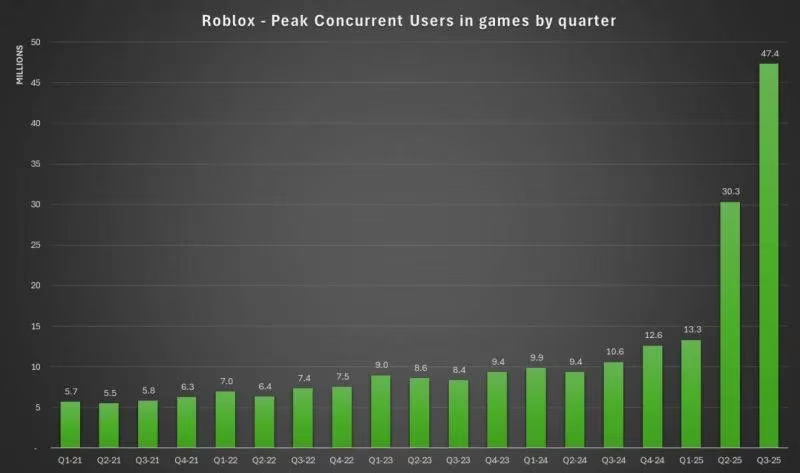
I remember the summer of 2025 like it was yesterday. My friends and I were glued to our screens, refreshing Discord servers and laughing at the escalating roasts between the creators of two Roblox games that had consumed our lives: Grow a Garden and Steal a Brainrot. Little did we realize we were witnessing history—a digital feeding frenzy that would push Roblox to a staggering 47.4 million concurrent players. As I’m writing this in 2026, that number still looms like a monolithic scoreboard in the sky, a testament to how a well-timed rivalry can turn a platform into a planetary event.

The rivalry everyone now calls the “Admin War” wasn’t some corporate marketing stunt. It was raw, unfiltered chaos born from two wildly popular titles that couldn’t be more different. Grow a Garden had players nurturing pixelated plants with the dedication of bonsai masters, while Steal a Brainrot was a gloriously chaotic scramble for meme-fueled treasures. Their creators began trading social media jabs—playful threats, absurd dares, even attempts to one-up each other with in-game updates. It was like watching two chefs in an open kitchen flinging ladles of hot sauce at each other, and instead of clearing the restaurant, the entire world pulled up a chair. The insults acted as gravitational waves, warping the player base and drawing millions into the vortex.
By the third quarter of 2025, the numbers had become almost mythical. Internal data from the analytics group Offpath, shared by Roblox Strategy Consultant James Purell, showed 47.4 million concurrent users—the highest ever recorded for any gaming platform. Grow a Garden hit 21.1 million at its peak, while Steal a Brainrot wasn’t far behind at 20 million. I’ve played MMOs that felt crowded with a few thousand people; imagining 47 million souls all pressing play at the same moment feels like trying to picture every star in the Milky Way suddenly blinking in unison. It was as if the platform had transformed into a cosmic binary system, with each game tugging players back and forth until the whole constellation collapsed into a supernova of activity.
What fascinates me most, looking back, is that this eruption of community happened while Roblox was navigating stormy waters. In 2025, the company faced lawsuits from parents and even the state of Louisiana over child safety concerns—valid criticisms that the platform is still working to address. Yet the developers of Grow a Garden and Steal a Brainrot didn’t let that overshadow their work. They kept building, kept engaging, and the players responded with an enthusiasm that cut through the noise. It reminds me of a street musician playing so beautifully that a crowd gathers even as sirens wail in the distance. Purell himself acknowledged the controversies but urged us to separate the executive battles from the creators who pour their hearts into these blocky virtual worlds.
And here’s the thing: that 47.4 million peak wasn’t just a flash in the pan. In the months since, Roblox has continued to evolve, but the energy of that Admin War left a permanent mark. Indie developers realized that a bit of playful antagonism—when done right—could be rocket fuel. Players saw that their passion could literally rewrite record books. For me, it’s a reminder not to underestimate the power of grassroots creativity, even inside a platform often criticized for its corporate machinery. Those two games weren’t created by giant studios; they were dreamed up by people who probably never imagined they’d shape a facet of gaming history.
As I write this in 2026, new hits have emerged on Roblox, and the safety conversation rightfully continues. But I’ll never forget that summer when a “beef” between two developers turned into a global bonfire. It’s proof that the most thrilling stories in games aren’t always scripted—they’re the ones we, the players, help write with every click, every login, and every meme we share. So here’s to the mad scientists behind the keyboard, the rivals who dare each other to be better, and the 47.4 million of us who showed up to watch the fireworks.
Comments